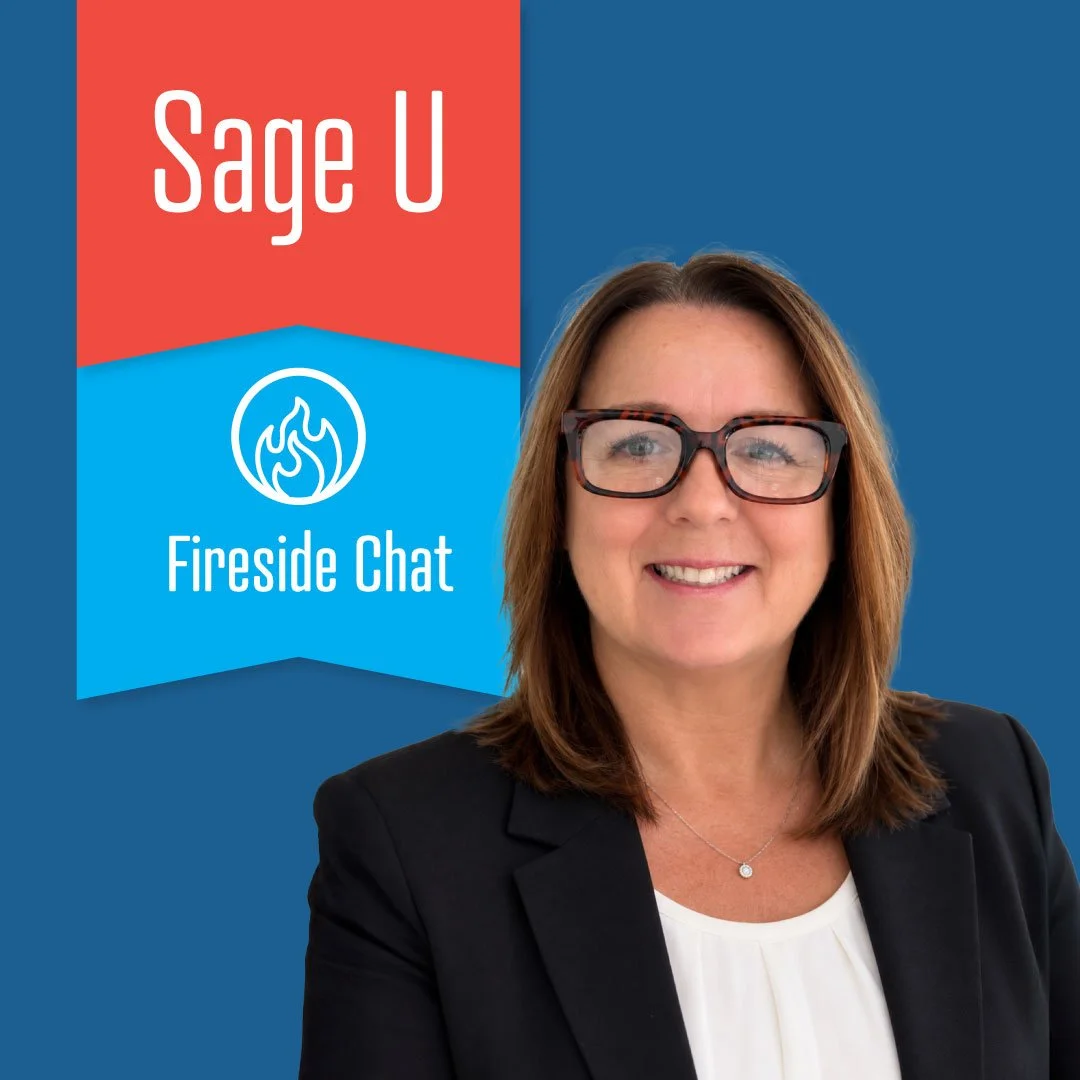
Bloom Where You’re Planted: Reliability, Resilience and Work-Life Balance
Sage is an organization filled with outstanding professionals who bring diverse backgrounds, experiences and expertise to their work. We leverage this depth of knowledge through our Sage U program, an all-learn, all-teach model, to support our team’s continued growth.
In this Q&A, Dawn Wilson, a longtime member of Sage’s accounting team, shares the career journey that led her to Sage and the behind-the-scenes work that keeps the agency running smoothly. She also reflects on the lessons that have guided her professional and personal life, including the importance of being a reliable problem-solver, learning from others, setting healthy boundaries and finding ways to “bloom where you’re planted.”
Q&A highlights:
Q: Can you tell us about your career path and how you came to Sage?
I knew from an early age that numbers were my thing. I took accounting in high school, studied it in college and completed several government internships. After graduating, I worked for the government for a few years.
My husband was in the military, so when we got married, we began moving to different locations. Continuing my government career was difficult at the time, which led me to work with small businesses across several industries, including healthcare, construction, real estate and nonprofits.
I eventually came to Sage through a temporary agency. I found temp work to be a great way to approach a role as a working interview and prove what I could contribute. I really liked the work, the people and Sage as a company, but I was still searching for a permanent position. When I told David that I had found one elsewhere, he said Sage could offer me a permanent role. That is how I became part of the team.
Q: What does the accounting department handle at Sage?
“Accounting” is actually a narrow description of what we do. Almost anything related to operating Sage as a business comes through our department.
That includes billing and paying invoices, but it also extends to benefits, paid time off, data management, reporting and many of the processes that keep the company running smoothly. A lot of the work happens behind the scenes and follows a cyclical schedule throughout the year.
Q: What principles have guided you throughout your career?
The first is to become a go-to person. Be present, reliable and committed to adding value. Try to become known as someone who solves problems rather than creates them. You don’t always need to know the answer, but you should be willing to help figure it out.
The second is to remember that anyone can be a mentor. You don’t have to hold a senior position to teach someone something new. We all have knowledge and experiences to contribute, including to our peers.
The third is to maintain work-life balance. I believe in working hard and then making time to enjoy life with family and friends. Being reliable doesn’t mean doing everything yourself. You also need to understand your limits, establish boundaries and know when to ask for help.
Q: What should people understand about military families?
Military families have a great deal to offer their communities. They’re often very community-oriented and civic-minded, but people may hesitate to form relationships with them because they know the family could eventually move.
My advice is not to shy away from those friendships simply because they may be temporary. Military spouses and children may sometimes feel excluded when others assume they won't be around long. No one can guarantee how long any person will remain in a particular job or community.
As a military spouse, I learned getting involved helped each new place feel like home. I volunteered at my daughter’s school, got involved in scouting and always went to the library soon after we moved to discover local activities. This helped us make connections wherever we landed
Q: What advice would you give to young professionals?
Follow your heart and pursue your dreams but remain grounded. Your career won't always look exactly the way you imagined. There will be difficult days when you question what you're doing, but one bad day doesn't necessarily mean you chose the wrong job or career.
As I often told my daughter, “Bloom where you’re planted.” I didn't enjoy every duty station we lived in, but I always tried to find something to appreciate. Some circumstances are temporary, and you can still find ways to learn, contribute and make the most of where you are.
Q: How can someone develop greater resilience?
When I first became a military spouse, I’d lived in Maryland my entire life and was accustomed to being surrounded by family and friends. Moving across the country pushed me outside my comfort zone, especially because I was naturally introverted.
Another military spouse took me under her wing and encouraged me to put myself out there. I realized I could either feel sorry for myself or move forward and make the most of the experience.
Having someone support you can make a tremendous difference. You also have to remind yourself that an uncomfortable situation may work out better than expected. Taking that step forward, even when the outcome is uncertain, is often how you grow.
Q: What is something your colleagues may be surprised to learn about you?
I’m a bit of a mixed bag. I enjoy being outdoors, paddleboarding and kayaking near my home, and I also practice archery and target shooting.
At the same time, I love shoes. I have more than 100 pairs and an entire wall in my closet dedicated to them. Unfortunately, working remotely means they are not worn as often as they once were!